
The Lab,
On Your Pad.
Independent, real-time measurement of how your frac fluid actually performs on location, stage by stage, while the stage is still pumping.
Pressure only tells you
half the truth
Today, the only live feedback on a frac fluid system is treating pressure. But pressure is a function of formation just as much as chemistry. When it climbs, it is hard to be certain what caused it, so friction reducer loading gets set as an input and left alone, or bumped up as insurance.
TruFlow™ turns FR loading from an input into a measured variable. It measures what the fluid is actually delivering (friction reduction, viscosity, sand loading, and water quality) live on your pad, so you can tell the difference between a formation change and a chemistry change, and size your loadings on data instead of insurance.
The result is more economical wells and better-performing fluid systems.
Every property TruFlow reports is one you would normally learn from a laboratory: a friction flow-loop result, a Fann 35 viscosity, a water quality panel.
Lab testing
Catch a sample, ship it, and wait days for a number describing fluid that no longer represents the job.
TruFlow™
The same measurements, run continuously at job conditions and timestamped against your treatment data.
Why it matters to you
- Detect water-quality swings, poor hydration, or under/over-dosing as they happen
- Right-size FR loadings with data, lower chemical spend, and target an FR%
- Objective by design: chemistry-agnostic, works with any supplier’s FR
Why DCS built it
- We already solve frac’s hardest hydration problem: dry polymer, hydrated on location, at rate
- Rheology and friction science is our lab’s core, now moved to the wellsite
- In-house engineers design, build and support our own automated equipment, backed by a 24/7 ROC
- The data path is already live: equipment → cloud → DCS360 on every DriFlow job
Seven measurements.
Seven answers you could not get before.
Measured at job conditions: the real water, chemistry, temperature and shear. No modeling, no inference from pressure. Just the measured value, while the stage is still pumping.
| Measurement | Method | Why It Matters |
|---|---|---|
| 01Friction Reduction vs Baseline | In-line flow loop | Confirm the FR is performing at the loading you are paying for |
| 02High-Shear Viscosity | High-shear viscometer | Verify fluid behavior in the pipe and through the perforations |
| 03Low-Shear Viscosity | Unique low-shear viscosity solution, correlated to Fann 35 | Verify the fluid’s proppant transport and suspension capability |
| 04Fluid Density & Sand Loading | Coriolis meter and high-shear viscometer | Verify proppant concentration matches the schedule |
| 05TDS & Hardness | Conductivity sensor with TDS & hardness correlation | Track and flag water quality that works against polymer performance |
| 06pH | pH meter | Monitor chemistry compatibility and stability |
| 07ORP | ORP meter | Monitor oxidizer presence for polymer degradation |
How TruFlow™ works
on your pad
TruFlow is a service, not just a sensor. It rigs up on the low-pressure side of the blender and draws from the blender discharge and, where applicable, the clean and dirty supply lines, so it measures the representative fluid going downhole. DCS runs it end to end; your team gets the answers.
Sample
A skid on location pulls a continuous slip-stream of treated fluid downstream of all chemical injection.
Measure
Real-time rheology of the as-pumped fluid: how it behaves under flow and shear, not just what was dosed.
Stream
Readings sync to a common timestamp with rate, pressure and FR loading: live in the datavan, in DCS360™, or through IWS and Corva.
Act
Adjust loadings or chemistry mid-stage. Every stage builds the baseline for the next pad.
See every stage in DCS360™
TruFlow data streams to DCS’s secure client portal, synced to a common timestamp with your frac data. The TruFlow dashboard compares the current stage against recent stages, flagging changes in your fluid system and isolating the variables that moved.
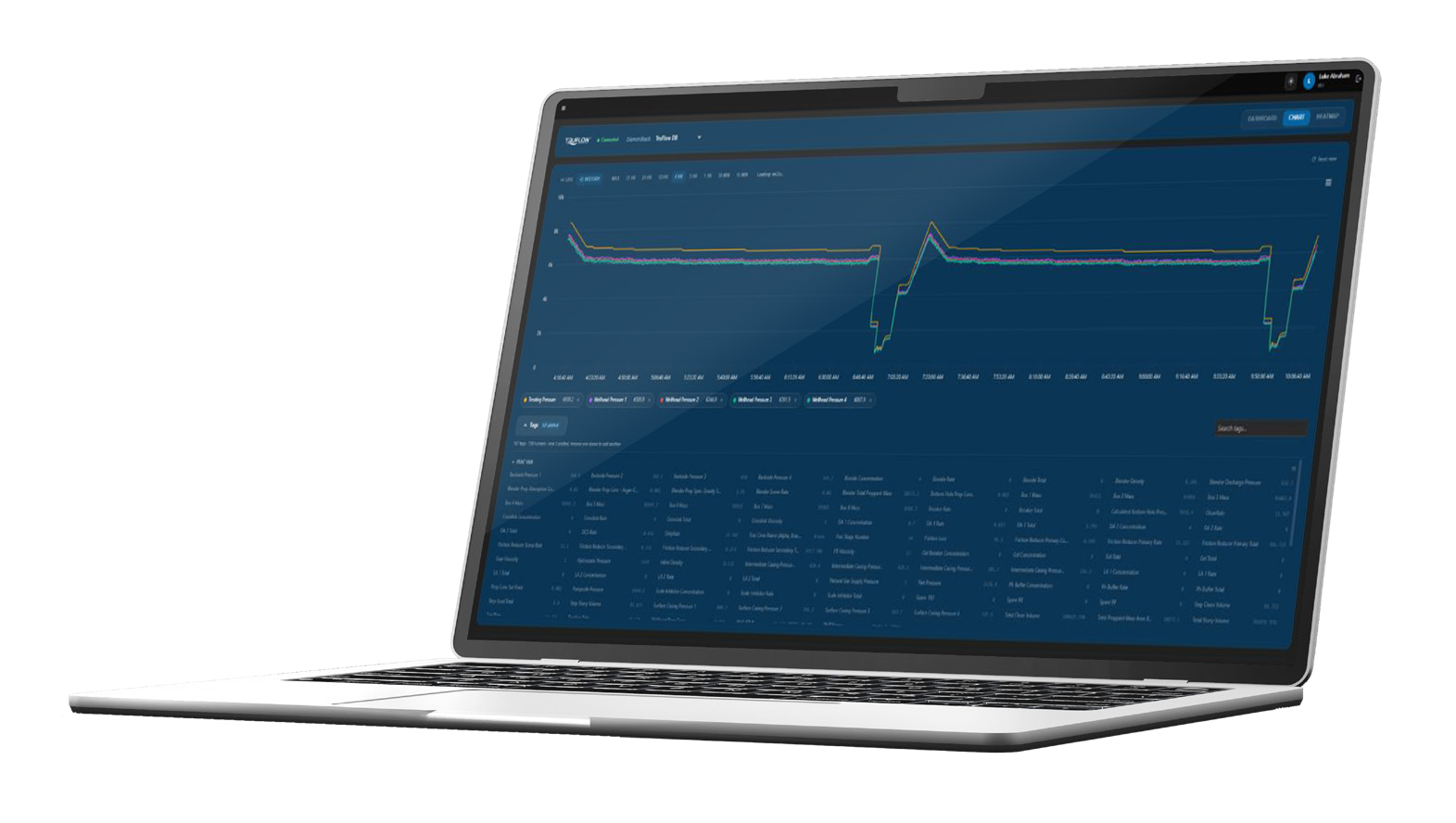
Customizable real-time plotting puts the data that matters most in front of you, on web, iOS and Android.
Explore DCS360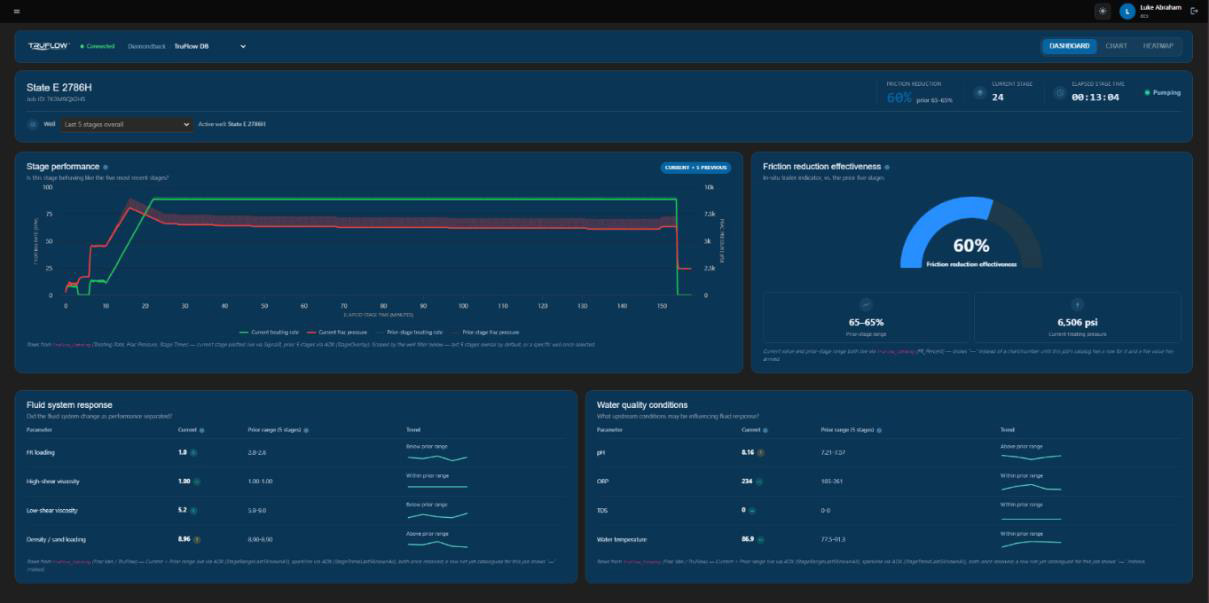
What DCS handles, so your crew doesn’t
Rig-up to rig-down
DCS field support rigs up, verifies data communications with every piece of equipment on location, rigs down, and moves the unit between pads.
Weekly service
Scheduled maintenance and calibration by a DCS technician, typically 1 to 2 hours and coordinated around your operations.
Engineering review
DCS chemical and fluid engineers review performance stage by stage to inform the next stage, then deliver a pad-level data review and KPI summary at rig-down.
Built for the way you frac
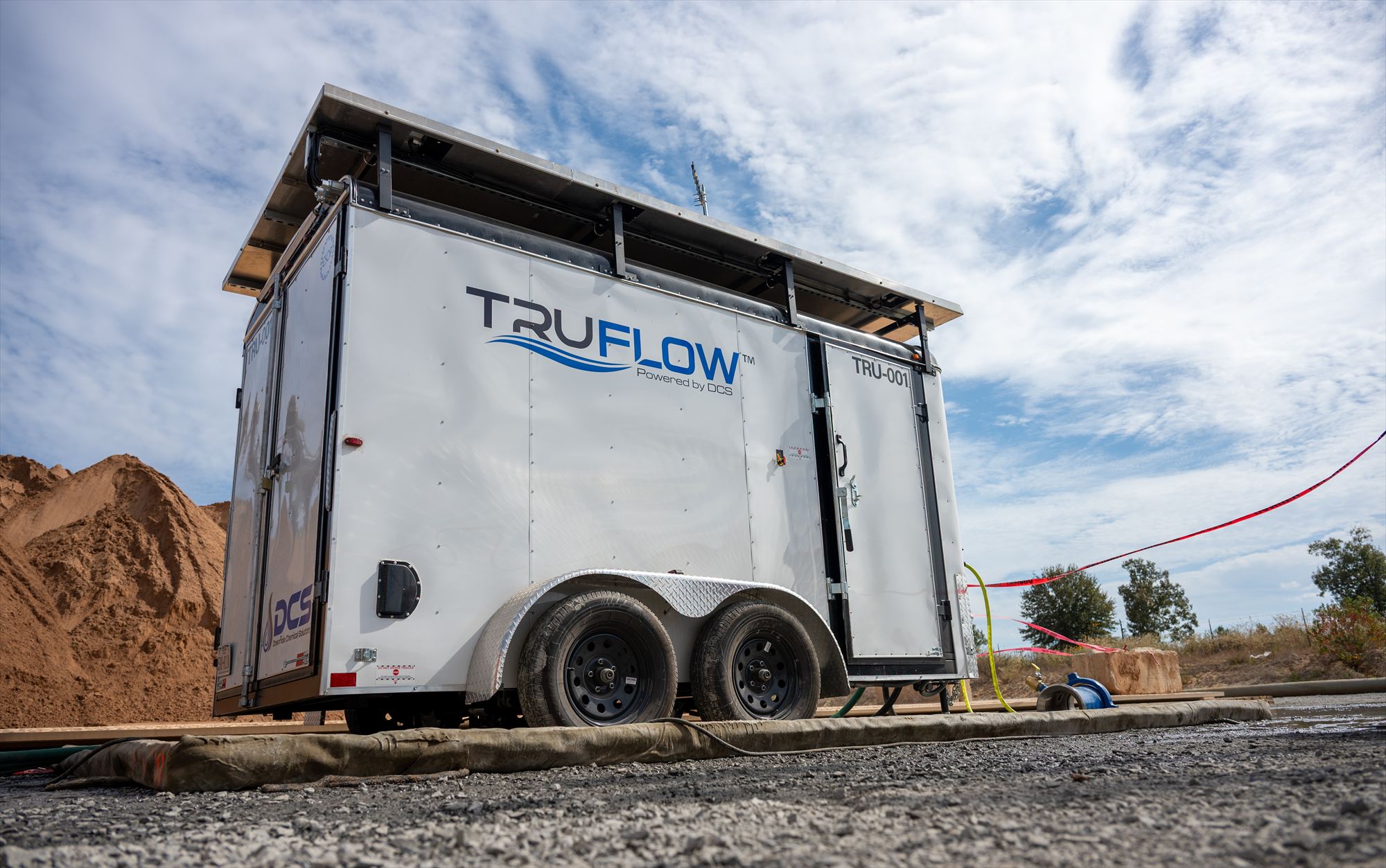
TruFlow is delivered to location as a self-contained unit with variability to accept multiple types of fluid systems based on your job’s requirements.
- Single-blender or split-missile. Works on traditional single-blender setups as well as split-missile configurations.
- Split-stream ready. Independent clean and dirty inlet ports blend two streams on the fly to match the clean-to-dirty ratio of your downhole design, so the measurement describes the exact fluid the formation receives.
- Self-powered. Solar with on-board battery backup, a DCS-supplied generator for extended periods without sun, and the ability to run on a standard 120-volt outlet.
- Compact footprint. Built into a 12’ enclosed trailer.